
The Heat Stress Drain: Why Your Nutrient Uptake Program Works Twice as Hard for Half the Result


Somewhere between your last soil test and today, your program began to lose ground. You didn't change anything. The heat did.
Your fertility plan looked solid in spring. Soil tests came back clean, your nutrient program was dialed in, and early growth confirmed you made the right calls. So why does that same program feel like it's underperforming right now, in the middle of summer?
It's not your plan. It's what summer heat is doing to how much of that plan your crop or herd can actually use.
What's Actually Happening Underground

When temperatures climb, every system you manage redirects energy toward survival instead of growth. Here's what that costs you:
Reduced transpiration pull: Plants close stomata to conserve water, which slows the transpiration pull that moves nutrients from root to shoot
Lower root zone oxygen: Root zone oxygen drops as soil temperatures rise, reducing microbial activity right when roots need it most
Energy diverted to thermoregulation: Animals divert energy to thermoregulation, pulling resources away from gain, milk production, or reproductive performance
Uptake efficiency falls regardless of supply: Nutrient uptake efficiency falls even when nutrient availability in the soil or the ratio stays exactly the same
That last point is what catches people off guard. You didn't change your program. The program didn't get worse. The conditions changed how much of it your crop or herd can actually absorb.
The Assumption Worth Questioning
Most input strategies are built around one idea: if performance dips, add more. More fertilizer, more feed, more supplement. But if the bottleneck is uptake and absorption rather than supply, adding more doesn't solve the problem. It just means more product sitting unused while the drain continues.
This is the moment to ask a different question. Not “what else do I need to add,” but “how much of what I already invested in is actually getting where it needs to go.”
It's Not Just Outdoor Heat, Either
If your growing environment is climate-controlled, greenhouse, or vertical, you might assume this doesn't apply to you. It still does. Indoor heat load, root zone temperature in substrate or hydroponic systems, and humidity swings during peak summer create the same uptake bottleneck, even when your ambient air temperature is dialed in. The drain isn't only an outdoor field problem. It's a root zone and metabolic problem, and controlled environments aren't immune to it.
Why This Matters More in July Than Almost Any Other Month

Early-season stress shows up in stand counts and emergence. Late-season stress shows up in yield and quality at harvest, when it's too late to course correct. Mid-summer heat stress works differently. It stays invisible in real time and quietly compounds for weeks before it shows up in the numbers you actually track, like weight gain, feed conversion, Brix, or root mass.
By the time the damage is visible, the window to fix it has mostly closed for this cycle.
Where AGT-R50 Fits
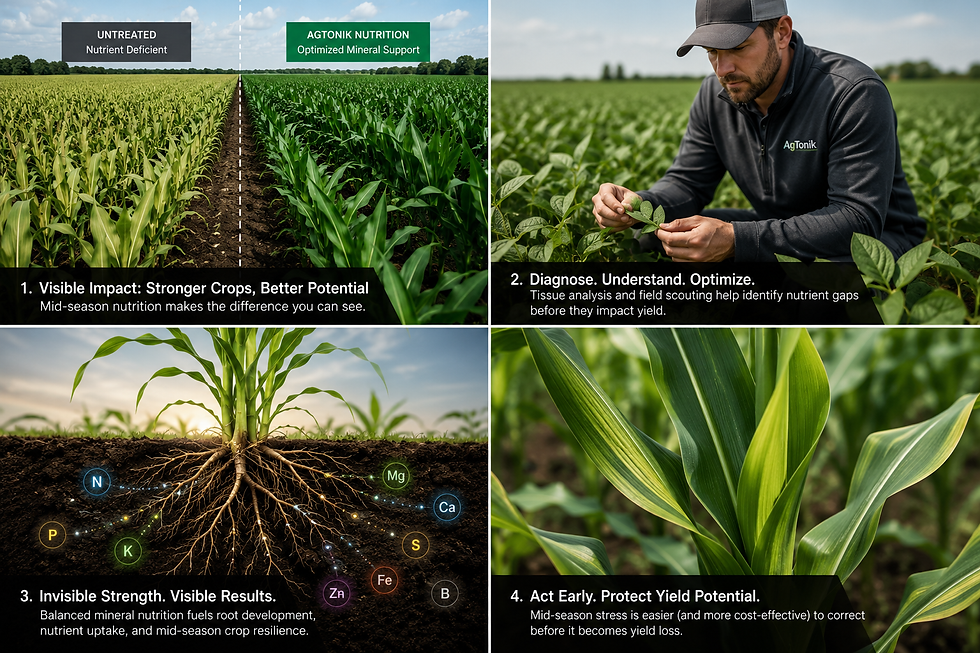
AGT-R50 doesn't ask you to add another product to a program already stretched thin by the heat. It's a fulvic acid trace mineral complex built to help the nutrients already in your soil, water, or ration become more bioavailable, so your existing investment performs closer to its full potential even when conditions are working against it.
That's the difference between an additive philosophy and an optimization philosophy. One assumes the answer is always more input. The other assumes you've already invested enough, and that the real opportunity is to make that investment work harder under stress.
What to Watch for Right Now
If you manage crops, check root vigor, leaf turgor, and nutrient mobility, not just visible canopy color
If you manage livestock or turf, watch feed intake, recovery time, and stress indicators that show up before performance numbers do
If your season's inputs are already locked in, focus on absorption and efficiency rather than adding new products to the mix
Heat stress is not a flaw in your program. It's a drain on it. The operations that come out ahead in summer are the ones that pay attention to absorption, not just application.
Your program already reflects a real investment in soil, substrate, or feed quality. The question this month isn't whether that investment was the right call. It's whether the heat is letting you see the full return on it.


Comments