
The Mid-Season Mineral Audit: What Your Crop (Mineral Nutrition) Is Telling You Right Now

Something shifted in your field three weeks after planting, and it is easy to miss. The seed went in on schedule. Fertility inputs were applied. The calendar moved forward. And then the season kept going. To the next decision, the next field, the next cost.
But the crop did not move on. It kept score.
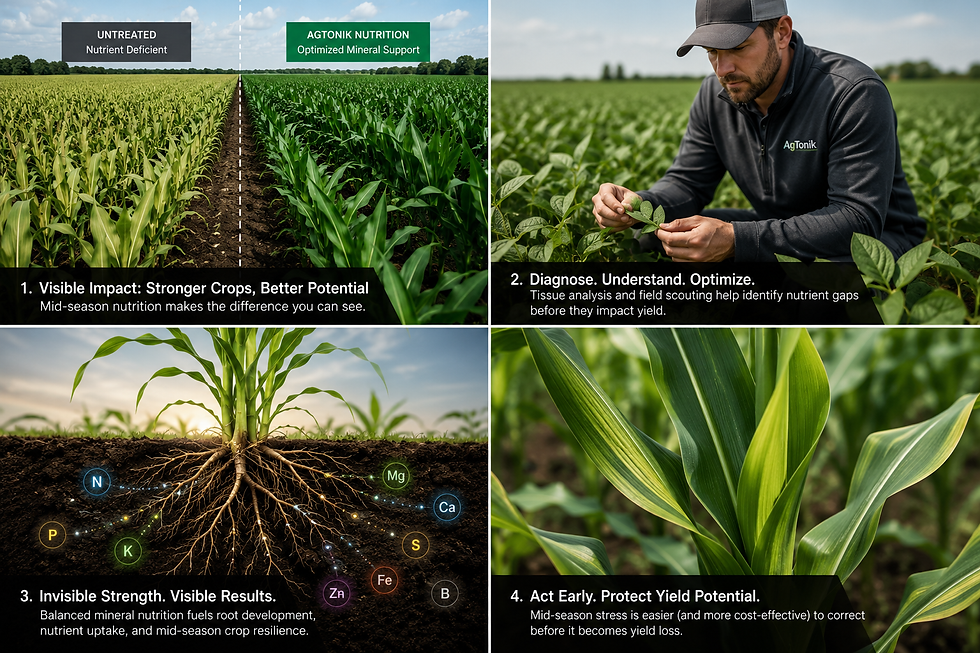
June is not a waiting period. It is the most underused diagnostic window in the entire growing season. The decisions you made in spring are showing results right now: in your root structure, in your canopy, in the biological activity beneath the soil surface. The question is whether you are reading those results before they become losses.
Here is what mid-season crop mineral nutrition is telling most growers right now:
Application and absorption are not the same number. What you put into the soil and what your crop actually takes up may be significantly different.
Soil biology slows under heat, compaction, and chemical load. When biology slows, mineral mobility slows with it.
A deficiency that shows up as a yield drag in August was already present in June. You just couldn’t see it yet.
Leaving minerals in the profile instead of in the plant is expensive. When input costs are elevated, the gap between what you applied and what your crop used is money sitting unused in the soil.
The Conversation
There is a conversation most agronomists have every August. A grower walks a field that underperformed and asks the same question: What happened?
The soil test looked fine. Application rates were on target. The inputs were there.
What was missing was rarely the mineral itself. What was missing was the biology to move it.
Soil is not a delivery system. It is a living system. When that system is under stress, whether from synthetic load, from compaction, or from temperature swings that push microbial activity to the margins, minerals sit in the profile, waiting. Your plant waits too. And yield potential quietly leaves the field while your attention is somewhere else.
The standard approach to mid-season nutrition is to look for visible symptoms and respond to what you see. Yellow leaves. Stunted growth. Poor tiller development. The assumption is that if the crop looks healthy, the crop is healthy.
That assumption is costing growers more than they realize.
What you see in the plant is a lagging indicator. By the time a deficiency is visible, the yield impact has already begun. Mid-season is not a time to react. It is a time to audit, to look at what is happening at the root zone, at the biological layer, at the interface between what is in your soil and what is actually reaching your plant.
Where AgTonik Changes the Conversation
AgTonik works at the biological interface. Its water-extracted fulvic acid trace mineral complex conditions the root zone environment, so the minerals you have already invested in become available to the crop that needs them. This is not an additive philosophy. It is a recovery and optimization philosophy: take what is already in the system and make it perform as it was designed to.
Fulvic acid is one of nature's most effective natural chelators. Its low molecular weight allows it to bind mineral ions, carry them across the root-zone interface, and deliver them into plant tissue, where many applied nutrients would otherwise bind to soil particles or leach away before the crop could use them. Paired with the bioactive trace minerals and antioxidants native to the AGT-50 complex, it addresses the gap that most fertility programs ignore entirely: the biological bridge between what is in the ground and what ends up in the crop.
When input costs are compressing margins from both ends, the most expensive decision you can make is to leave the investment you already made sitting in the profile.
A Single Question
The mid-season mineral audit is not a complicated process. It starts with a single question: Is everything I put in the ground this spring actually reaching my crop?
If you do not know the answer, that is your answer.
AgTonik gives you a way to close that gap, not by adding another layer of inputs, but by supporting the biological foundation that makes your existing investment work the way it should. This is not about spending more. It is about recovering what you have already spent.
The season is not over. But the window to course-correct is closing. What you do in June determines what you harvest this fall.
Book a consultation to build your mid-season mineral audit before the window closes.


Comments